YOGA IN THE TRADITION OF SRI KRISHNAMACHARYA AND SRI DESIKACHAR


YOGA


individual, personal, one-on-one: because no two people are alike.


YOGA TEACHER/COUNSELLOR
SAMITA
  • Internationally certified Yoga acharya with distinction.
  • Master in Science of living, Preksha meditation & Yoga.
  • Qualified clinical hypnotherapist and counsellor.


Contact 
FOR YOGA/COUNSELLING APPOINTMENTS/CONSULTATIONS
Bangalore 
+91 9663505412  
Email yogarpanam@gmail.com  
www.yogarpanam.blogspot.com  

YOGA TEACHERS BKS IYENGAR, RAMASWAMI SRIVATSA, BKS IYENGAR, SRI PATTABHI JOIS, VANDA SCARAVELLI, INDRA DEVI STUDIED UNDER SRI KRISHNAMACHRYA. 
J KRISHNAMURTHI WAS ALSO ONE OF THIER STUDENTS. 

1.ASANA/PRANAMAYA/DHYANA CLASSES. 

2.YOGA PHILOSOPHY-YOGA SUTRA CHANTING/THEORY. 
3.YOGA THERAPY CLASSES FOR PHYSICAL AILMENTS-(One to one only).
4.YOGA THERAPY CLASSES FOR PSYCHOLOGICAL
AILMENTS-(One to one only).

5.VEDIC CHANTING 6.COUNSELLING 7.YOGA WORKSHOPS

A YOGA PRACTICE FORMULATED SCIENTIFICALLY WITH COMPLETE FOCUS AND KEEPING IN MIND, THE INDIVIDUAL'S PHYSICAL MENTAL AND EMOTIONAL NEEDS. 

YOGARPANAM HAS BEEN INSPIRED BY THE LEGENDARY YOGA TEACHER 
SRI T KRISHNAMACHARYA.THE TEACHINGS OF SRI KRISHNAMACHARYA AND HIS SON SRI DESIKACHAR HAVE BEEN PHENOMENAL.YOGARPANAM, IS MERELY AN EXPRESSION OF THIS IGNITED INSPIRATION.

REAL GROWTH HAPPENS WITHIN. 
AND YOGA HELPS.

PEACE ALWAYS.
REGARDS.
SAMITA.


Parinama with reference to the chapters of Yoga Sutra by Samita Rathor


Parinama with reference to the chapters of Yoga Sutra
“Explain Parinama with reference to the chapters of Yoga Sutra”.

"Yoga serves the individual, and does so through inviting transformation rather than by giving information." T.K.V. Desikachar

The mention of the word Parinama comes in SADHANAPADAH 2.15 as one of the causes for dukha.

2.15 Parinama tapa samskaradukhaih gunavrittivirodhacca dukhameva sarvam vivekinah

According to a viveki (discriminatory knowledge) the world is full of dukha (suffering) due to Parinama (change), samskara (conditioning), tapa (craving) and guna vritti (movement in the gunas). The background of every spiritual teaching is to get out of dukha. If we get out of suffering dukha ends and that in itself is Parinama.

Change in place, change in relationship, change in relationship can cause dukha.

According to the Kapila’s Samkhya philosophy there are 3 causes for suffering

1. Adhyatmika-caused by self

2. Adhibhoutika-caused from the bhutas. E.g. a snake bite.

3. Adhidaivika-caused from supernatural forces. E.g. tsunami or floods.

In VIBHUTIPADAH SUTRAS 3.9 - 3.16 talk about the 3 Parinama

3.9 Vyutthananirodhasamskarayoh abhibhavapradurbhavau nirodhaksanacittanvayo nirodhaparinamah

The samskaras of one who is in a state of vyutthana(coming out), when he is trying to be in command of the thought waves as they appear and disappear, then the mind connects with the moment it is a Nirodha Parinama.

How does one get Nirodha Parinama?

After continuous practice and lot of effort one gets the power to be in command of the mind. The moment the samskaras accumulate during vyutthana state, the practitioner is able to recognize them. The connection of the mind at this moment is Nirodha Parinama.

The samskaras are the characteristics of the mind. The Parinama of samskaras are taking place in us every moment.

According to Sri Desikachar-“the mind is capable of 2 states based on 2 different tendencies. These are distraction and attention. However at anyone moment only one state prevails and this state influences the individual’s behavior attitudes and expressions.”

3.10 Tasya prasantavahita samskarat

Fruits of Nirodha Parinama

When the habit of restraint and nirodha is formed there is effortless flow of peace tranquil and spontaneous flow of movement of nirodha where the thought waves have restrained themselves.

3.11 Sarvatataikagratayoh ksayodayau cittasya samadiparinamah

When all pointedness of the mind subsides and one pointedness rises it is called Samadhi Parinama. The nature of the mind is sarvart (all pointed). It can be made one pointed and when this is done there is an inclination towards Samadhi. A mind in ekagrata itself is a Parinama.

3.12 tatah punah santoditau tulyapratyayau cittasya ekagrataparinamah

When the mind is no more bothered when the thought waves rise or subside and is being able to concentrate on one single point it is called Ekagrata Parinama.

We all have a state of shanta (undisturbed/down) and udita disturbed (up) mind. When it is in a state of balance there is one pointedness.

How can we visualize these 2 different states of shanta and udita?

Pranayama and abhyasa helps us visualize shanta and udita. Only in a state of santa we can reflect on an object .It is a state of no thought waves.

3.13 Etena bhutendriyesu dharma lasksana avastha parinamah vyakhyatah

The dharma, laksana and avastha can change. Kala brings change.

Parinama can be divided as

1. Dharma (properties) gets influenced by the 3 gunas and food. Astanga yoga, diet and moderate activity are the factors.

2. Laksana (character) gets influenced by external factors like sangha.

3. Avastha(condition) which gets influenced by kala and factors like which stage of life one is in. One’s activity should synchronize with kala.

3.14 A dharmi who possesses dharma may have characteristics that may be (santa) dormant), udita (arisen) or avyapadeshya (manifested). Dharmi does not undergo any change.

3.15 The dharma possessing different characteristics in the (santa) dormant), udita (arisen) or avyapadeshya (manifested) is the cause of the different modifications of the thought waves.

3.16 If we practice dharma, laksana, avastha and samyama then one can get past knowledge and what is going to happen in the future.

KAIVALYAPADAH 4.12-4.15 talks about the Concept of Parinama

4.12 Atitanagatam svarupatatah asti adhvabhedaddamanam

Whatever will appear in the future or has appeared in the past is essentially in a dormant state. What is past has not disappeared forever.

The substance of what has disappeared as well as what may appear always exists. Whether or not they are evident depends upon the direction of change. the past existed as past and also the future. Objects and events are closely related. Without any object there are no events. Past seems like imagination but it does exist. Past and future is not a fabrication of the mind. Sat karya vada.The world is real and exists but it is subject to change. Consciousness and matter exists. It is neither created nor destroyed. It undergoes change continuously. Creation is nothing but change.

4.13 Te vyaktasuksmah gunatmanah

Objects make events. All objects are made of 3 gunas. These are sometimes fully blown and sometimes subtle.

4.14 Parinamaikatvat vastutattvam

The raw material of objects are the 3 gunas. Difference in these objects is merely a difference in the combination of the gunas.

4.15 Vastusamye cittabhedat tayorvibhaktahpanthah.

Objects are always the same but perceived by different mind in different ways. Sri Desikachar gives an example how a Hindu temple is a place of worship to the devoted believer, an artistic monument to the tourist, a place of solicitation to the beggar and even a place of ridicule to atheist. This is a very important sutra for personal relationship. We always find fault in others. Allow the other persons opinion to be heard by you.

RESULT OF PARINAMAS

4.32 Tatah krtarthanam parinamakramasamaptigunananam

Our activities are nothing but combination of the gunas. Gunas are controlled by samskaras. At this stage the gunas totally cease.

4.33 Ksanapratiyogi parinamaparanta nirgrahyah kramah

Parinama is a quality in prakriti based on a particular karma. Citta vrittis and gunas are going away here as is no samskaras. Klesas become inactive. Parinama comes to an end. Citta vritii nirodha.

SOME IDEAS ABOUT PARINAMA

· Parinama is one of the most important concepts in the Yoga Sutra of Patanjali.

· It means change from the philosophical and practical point of view.

· The concept of Parinama is not just for the mind but also the bhutas (elements) and indriyas (senses).

· How the universe came into existence is due to Parinama. The universe is constantly going through changes.

· Parinama is present in Prakriti which is always changing due to the presence of the 3 gunas rajas, tamas and satva.

· It is a key-concept in the Samkhya philosophy on which PataƱjali's Yoga Sutras are based, and also in the philosophy of the Vedanta. It is a key concept, because, Samkhya or Yoga thought in Indian philosophy is classified as 'parinama-vada' or also 'satkaryavada'.

· Samkhya and Yoga believe, that when e.g. a tree grows out of a tiny seed, this proves that this mighty tree must already have been present in the seed, be it in a hidden way. For the tree cannot emerge out of nothing. In the same way the whole visible world must have emerged out of a world-seed, in which it existed in a non-manifest way before it appeared.

· In Yoga and Samkhya the whole of life is a projection of something that lies hidden deep inside.

“The Mastery of Yoga must not be measured simply by the ability to master the techniques of yoga like asana and pranayama, but by how it influences our day-to-day living, how it enhances our relationship and how it promotes clarity and peace of mind.”

~ T K V Desikachar


YOGARPANAM VINYASA
YOGA STUDY AND HEALING CENTRE


Rather pursue truth than pretend to know. Rather share knowledge than proclaim to be an authority on it. Rather practice than preach. Rather be in stillness than sound. When we think we are an authority on something it’s a manifestation of powerlessness and fear. To be a true yoga and spiritual practitioner one requires a great amount of love, compassion and selflessness. Knowledge without these qualities is as good as an ocean without water. Achieving tough asanas and bending in all directions have no meaning if the foundation of truth is missing. The toughest part of a yoga sadhana. This is what my inner core truly believes. Samita.

YOGARPANAM VINYASA-YOGA STUDY AND HEALING CENTRE

DEVELOP YOUR PERSONAL YOGA PRACTICE
YOGA CLASSES (TAUGHT IN THE TRADITION OF SRI T.KRISHNAMACHARYA AND SRI T.K.V.DESIKACHAR)

  1. ASANA/PRANAMAYA/DHYANA CLASSES
  2. YOGA PHILOSOPHY-YOGA SUTRA CHANTING/THEORY
  3. YOGA THERAPY CLASSES FOR PHYSICAL AILMENTS-(One to one only).
  4. YOGA THERAPY CLASSES FOR PSYCHOLOGICAL AILMENTS-(One to one only).
  5. VEDIC CHANTING
  6. COUNSELLING
  7. YOGA WORKSHOPS

CONTACT
Samita
CLASSES ARE HELD IN BANGALORE, INDIA.
EMAIL yogarpanam@gmail.com
(appointments by email only)
WEB http://www.samitarathor.blogspot.com/
CONSULTATION
WITH PRIOR APPOINTMENTS.
NO PHONE CONSULTATIONS AND HOME VISITS.

A YOGA PRACTICE FORMULATED SCIENTIFICALLY WITH COMPLETE FOCUS AND KEEPING IN MIND, THE INDIVIDUAL'S PHYSICAL MENTAL AND EMOTIONAL NEEDS.
“Teach what is inside you, not as it applies to you, to yourself, but as it applies to the other.” Sri T. Krishnamacharya.
The heart of the teachings of Desikachar, and his teacher Sri Krishnamacharya. So, the practices that are taught, and the way that they are taught, will vary according to the individual and the situation. He believed that yoga should always be adapted to the requirements, situations and goals of each individual, never the individual to fit the yoga.
They refused to standardize the practice and teaching methodology.

PRESS RELEASE


Samita conducting a workshop with the 240 energetic bunch of Symbiosis in Lavale.

PRESS RELEASE:
WORKSHOP ON UNDERSTANDING & DEVELOPING AN INDIVIDUALIZED PERSONAL YOGA PRACTICE BY SAMITA RATHOR

Individualised Yoga- The Essence of Healthy Living:
By: Priyanka Chakrabarti
Located among lush hills, Lavale offers a chance to coexist with nature as it stands over a valley surrounded by clouds and painted green in its best season. Powered by solar sources, its eco-friendly functioning makes for a perfect setting for contemplative and incisive study far from the worries and hustle of the city. Designed to conserve natural resources, the Lavale campus incorporates a rain water harvesting project to conserve water and re-use it effectively for various purposes. Envisioned as a green zone, students are encouraged to walk and bicycles have been provided for transport. Known as the Symbiosis Knowledge Village, Lavale is home to Symbiosis Institute of Media & Communication (SIMC)
October 7th, 2009, at the fag end of the semester, when the threshold of the exams had just passed, the students of Symbiosis Institute of Media & Communication were exposed to a scintillating experience of yoga. Samita Rathor conducted this session, and enlightened about 240 students about the importance of the practice of personalized yoga and how it helps one to regulate the inner self.
Samita Rathor has been a student of yoga , under the guidance of Sri T.K.V. Desikachar son of Sri T Krishnamacharya, who happens to be one of the greatest yogis of contemporary times from a 9th century Yoga lineage. Her primary focus is to educate people about different kinds of healing techniques from physical, mental and emotional trauma, through the implication of Individualised Yoga.
Students were projected to six hours of authentic informative session, where different kinds of yogic postures and breathing techniques were unveiled. These help one to accomplish sync between the body, mind and soul. But most importantly prominence was laid on formulation and connotation of individualized yoga.
Samita Rathor chanted “Samatvam Yoga Uchyate ( from the Bhagwad Gita),” which means equilibrium of the mind is yoga. She believes in the fact that every human being is composed of different components and hence each one of them is unique. Every individual have distinctive mental, physical and emotional stratum, thus to cure the various sections of the body and mind, a very explicit and detailed form of yoga, catering to the essential needs of a person is to be appropriately designed. This is the time when the need for a personalized instruction is required for attaining best and incorrigible form of yoga training. In fact, this is the customary yoga philosophy and faith of Sri Krishnamacharya and his son Sri Desikachar.
Yoga helps one to enhance one’s intuitive powers. A personal yoga practice is a very private experiential course of action, which leads to the inspiration of higher senses. It helps to build up awareness on emotional level; whereon it leads to obliteration of negativity. Moreover yoga essentially helps one to focus more, get distressed, it slows down the pace of aging and lastly it helps one to totally get detached from one’s own body and get connected to the universal energies. After certain age yoga needs to be individualized, hence all these results cannot be accomplished in group practice.
Samita portrayed different forms of asanas, which eventually is a course of journey from noise to silence, self-adherence and composition. She imparted the knowledge imbibed with rationality and logic.

ON SAMITA RATHOR

Samita Rathor has had the fortune of being blessed and has been exposed to various philosophies under world renowned masters like Sri T.K.V.Desikachar & his daughter Mekhala Desikachar(was initiated into Yoga and owes all her knowledge/teachings to him), His Holiness The Dalai Lama(Buddhism), Venerable Sangye Khadro(Buddhism), Swami Mahadevananda/Swami Govindananda(Vedanta Philosophy), Swami Sivaswaroopananda/Prahald (Anatomy and Physiology/Hatha Yoga), JVBI under Acharya Mahaprajna(Jainism).
Samita's application of a one to one approach(as per the tradition of Sri Krishnamacharya and Sri T.K.V. Desikachar) has appealed to many serious yoga student's who hail from reputed and eminent backgrounds.
Her style of teaching is unique and the results have been very positive.
She has healed and helped people suffering from various physical mental and emotional imbalances through yoga and counselling.
Samita has had experience in various fields such as the corporate sector, advertising, film, theatre, television and modelling. She is able to connect and understand the needs of the students almost instantly and that is a unique quality she posseses.
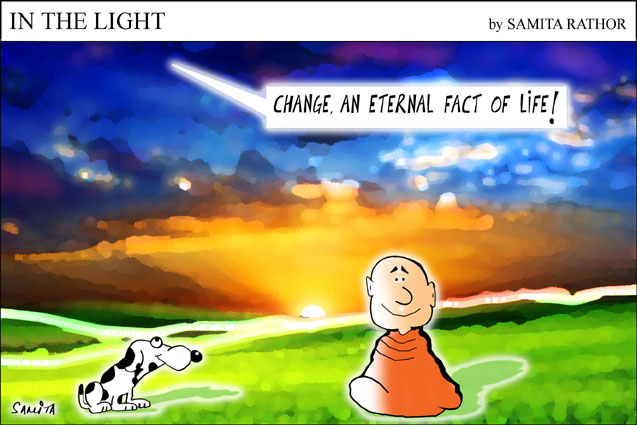
She is the founder of Dog Adoption Foundation which is a non profit voluntary group helping in adoptions of animals in distress who need homes.Also a cartoonist and writer publishing for eminent publication for over a decade. Her columns Soul Value, In The Light and Samita's World are published in Civil Society.

YOGA CLASSES TO SUIT EACH INDIVIDUAL'S UNIQUE REQUIREMENT

UNIQUENESS OF YOGA AND AN INDIVIDUAL
“Teach what is inside you, not as it applies to you, to yourself, but as it applies to the other.” Sri T. Krishnamacharya.
“The mastery of Yoga must not be measured simply by the ability to master the techniques of yoga like asana and pranayama, but how it influences our day to day living, how it enhances our relationship, and how it promotes clarity and peace of mind.”
T. K. V. Desikachar
How many of us go to a doctor in a group to get our ailment treated? Do doctors see patients suffering from an ailment on a mass level? Each aliment has to be treated individually and specifically. Similarly a yogic practice needs to be addresses based on the individuals physical, mental, emotional and spiritual make up. Our body is made up of so many different components and their composition is unique. No two individual’s, how much ever similar, can have the same chemical equation in their bodies. What we eat, what we drink, our preferences, are logically and scientifically poles apart. Our pranic or vital energy levels are dependant on a lot of aspects and even they differ from person to person. Keeping this in mind it is very evident that each individual is a unique configuration of energy.
BENEFITS OF AN INDIVIDUAL ONE TO ONE CUSTOM-MADE YOGA TRAINING
· Experience of awareness and calm.
· Suits the needs of individual’s physical mental and emotional make up. An extremely important point in this day and age. A group practice does not do this.
· There is no chance of any serious injury as an individual practice development is a steady logical progression. Occurrence of injury in a group practice is far higher. There can also be cause for serious injuries as the individual may not be physically or mentally adjusted to that particular posture or practice.
· A one to one Yogic practice can be done at any suitable time.
· A personal practice is a very confidential experiential process which leads to stimulation of our higher senses and nature.
· It keeps an individual totally in touch with the different changes that occur emotionally. Awareness on an emotional level leads to action and eradication of the negative emotion. Negative emotions can be a root cause for many serious diseases.
· Our breathing capacities are different. A one to one training in yoga will use the breath of the student to his best potential along with the right ratios of breathing, building them up gradually. · Yogic practices done in groups may have some physical motivational value but a tailor made yogic practice has not only a holistic motivational value but also secure a positive growth on a physical, mental, emotional and spiritual level.
· Place and space is not a constraint and an individual yogic practice can be done anywhere. It is more realistic and in accordance to our day to day existence.
· A real Yoga teacher will always focus on an individual on a one to one level. Therefore an individual practice will bring you closer to a traditional and genuine yoga guru.

CAN 2 PEOPLE HAVE THE SAME PHYSICAL MENTAL & EMOTIONAL MAKE-UP ? NO…IT’S NOT POSSIBLE. THEN HOW CAN WE TEACH THEM THE SAME THING? THIS IS THE PURE TRADITIONAL YOGA PHILOSOPHY AND BELIEF OF SRI T. KRISHNAMACHARYA AND HIS SON SRI T.K.V. DESIKACHAR.
We have a unique physical, mental and spiritual level, which differs from person to person. This is when we need a one-on-one instruction, the real, best and long-established form of Yoga training. The student consults the teacher regularly and practices what’s specifically designed for them, daily. The student provides feedback so that the practice can be polished and made more individual specific, as required. Yoga becomes an individual journey, and the learner develops the skills to observe the subtle changes that occur in his or her own physical, mental and spiritual level.To heal these different areas of the body and mind, a very specific Yoga grounding based on the individual’s need is taught to be followed daily. After a certain age Yoga needs to be individualized. Initially group yogacould prove hazardous if done without examining the student, physically, mentally and emotionally. Getting to know a person on these 3 levels is a time consuming process, which evolves over a period of time.

YOGARPANAM: A Tribute to Its Masters

One to One Yoga Classes in the Tradition of Sri Krishnamacharya and Sri T.K.V.Desikachar. A YOGA PRACTICE FORMULATED SCIENTIFICALLY WITH COMPLETE FOCUS AND KEEPING IN MIND, THE INDIVIDUAL'S PHYSICAL MENTAL AND EMOTIONAL NEEDS. YOGA MASTERS: YOGARPANAM: A TRIBUTE, HAS BEEN INSPIRED BY LEGENDARY YOGA TEACHERS LIKE SRI T KRISHNAMACHARYA AND HIS SON SRI T K V DESIKACHAR. THEY HAVE LED THOUSANDS OF PEOPLE TO BECOME AWARE OF YOGA AND IT'S TRUE ESSENCE. THE TEACHINGS OF SRI KRISHNAMACHARYA AND HIS SON SRI DESIKACHAR HAVE BEEN PHENOMENAL.SRI DESIKACHAR WAS THE ONLY ONE WHO HAD THE PRIVILEGE TO STUDY UNDER HIS FATHER CONTINUOUSLY FOR 30 YEARS.LEGENDARY YOGA TEACHERS BKS IYENGAR, SRI BNS IYENGAR, SRI PATTABHI JOIS, VANDA SCARAVELLI, INDRA DEVI STUDIED UNDER SRI KRISHNAMACHRYA. J KRISHNAMURTHI WAS ALSO ONE OF THIER STUDENTS. YOGA MASTERS: IN THE LIGHT: A TRIBUTE, IS MERELY AN EXPRESSION OF THIS IGNITED INSPIRATION. REAL GROWTH HAPPENS WITHIN. AND YOGA HELPS.

http://www.facebook.com/?ref=home#!/group.php?gid=21700393134&ref=ts